Sunday, February 10, 2013

MIRR Follow Up

MIRR = Modified Internal Rate of Return: a metric used to rate the efficiency of an investment.

So I'm talking to my work buddy Mike and I say... There's this website I go to that has data in a spreadsheet type format. Would you know how to write a program that could pull data from these spreadsheets? Yeah I could do that... That would be fun. Two hours later I've got a seed program.

I took the seed and wrote additional code that directed the seed here and told it to download this and that. Go to one of the offers and you'll see what I mean about how the form is structured. Bing Bang Boom The program downloaded 7100 individual system breakdowns dating back to mid-2010. The program captured data on system price, system size, module size, module cost, expected performance in terms of kWh/kWp, financing rates, borrowing percentages and so on.

I ran the relevant data through an economic analysis that calculated LCOEs, IRRs and MIRRs for all the systems - the MIRR graph is to the right. The graph is plotted by date. June 2010 data starts at the top and then 4500 data points later we're down to January 2013. It completely trips me out how the MIRR line hugs around 10% so strikingly. This is crazy. The FiT rates fell from 34 to 17 cents/kWh from the start to the end of the data set. The data covers systems of different sizes receiving different FiT rates. Average system costs fell from 3000 to 1500 Euro/kW during the span! How could this metric hold consistent throughout that multi-directional madness? Must be magically magnetic man.

MITCH: Did he just pour on the corn?
BUTCH: That was definitely a corn foul.
CONSUELO: WTF are ju jokers talking about?

I admit I have my reservations. I massaged the data some. Could be my calculations have some bugs. And ya know it may be something about MIRRs I don't understand. Sure looks interesting though. Hope it stays interesting upon cross-examination.

*About 2500 systems were scrubbed due to gibberish and/or incomplete data. The scrubbed systems were evenly dispersed in the set.

Friday, February 8, 2013

Ermhagherd


QOTD

Soft costs is a euphemism for middle men.

BOTEs

A multicrystalline cell measures 156 mm on a side and there are 60 per module. Average module power is about 200 Watt so you need 5 modules per kW. There are 100 GW of photoelectrics installed Globally. That's one hundred million kW made up of around 30 billion solar cells. Solar modules would cover nearly 750 square kilometers if laid flat, Photoelectrics currently supply a little over one half of one percent of the world's demand for electricity. We should hit the1% supply mark in a little over a year.

25% Growth Adds Up

In 10 years over 1000 GW of photoelectrics could be installed globally supplying over 5% of the world's electricity and generating a trillion dollars in economic activity. A Generation from now over 15% of the world's electricity could come from sunshine - Over 30% in 30.


The Sociopathic Intern - Boastradamus

The Christmas party was going smoothly until the sociopathic interns' Ayahuasca Cookies kicked in. Emily Kane had two before she started speaking.

In the Military you're a name on a list that's tacked up on a wall. The list tells you to move to South Carolina to work your ass off in a city that has the worst drinking water quality in the nation. Yum... Today you're my Army and I'm going to divide you up and send you off to yummy places and you're going to like it. Four Teams. Four Missions.

Team A - Keep making the digital cameras.

Team B. We've got an arc of projects ahead of us. You're going to apply your Pompotous advertising knowledge to produce the Fuck out of our products and our brand. We're going to call our cameras, Kameras from now on. Harder K like an Asian would say it. All our products are going to get corny Asian themy names from now on. Everybody loves Asian Corn. Your goal is to make this company The Domino. Which domino is The Domino? Which else? The moving one! Boom-boom-boom... Produce our Products.... Boom-boom-boom. Make us a Top Shelf Brand that everybody knows is worth it. Make us The Domino!

Team C. You're going to build miniature digital music players and tiny phones and handheld computers. We're going to expand our product line for several years but then things are going to converge on an everything device - An E-thing. ETs do more than phone home. When I say everything I mean everything. Your phone is a camera, a translator, a chess grandmaster, an AED, a color R2-D2 3D projector with Bose sound that is able to project a three dimensional Hypnotic Sensei Doctor capable of giving lifesaving tutelage (using the AED feature where required), a grief councillor, a Taser,  a laser pointer, a thermostat...  We'll have to make a Swiss Army Version... It will be cherry Red, metal ribbed but able to get on an airplane... Got it yet? Chop Chop.

Team D. It's 2001... Space is Calling... You're going to be our Sun Gods. Deep Space Skunkworks R&D division. The ideas you build here are going to change the world. We're going to use our printing technology to lower the cost of solar manufacturing. We're going to change how solar panels are made. Think large solar sheets held vertically to the ground and stationary - the process tools will move around either side simultaneously. We'll print the same sort of computer chips that our digital Kameras have onto our solar wafer wall - the designs won't process images - our Sun Chips will handle each cell's network communications, power conditioning, fire and grid protection, maintenance and so on. The goal is to have an everything version of the Sun Chip that costs less than a penny per watt. When we unstealth we're going to rebrand as Clear Power with a tag line of Boldly Going.

See how the engine works? Spark. BAM! Expansion... Power Stroke... Convergence. Spark BAM! Repeat. See the Cycles? Each supplies the Existence Theorem for the next. We did this so we can do that. Why is everyone dancing? Who invited Donkey Kong?

Thursday, February 7, 2013

Photoelectricis in Saudi Arabia vs. Norway

During the summer the Saudi Arabians guzzle about a million barrels per day not to drive or to manufacture petrochemicals but to generate electricity. In round numbers that's 100 million dollars a day in potential oil sales. If you assume a 40% conversion efficency you can get right around 666 kWh from a barrel of oil. A BOTE calculation reveals that the opportunity cost of the electricity generated from oil is in excess of 15 cents/kWh. If the Saudis could find something like say photoelectrics that produced electricity for 7.5 to 10 cents/kWh they'd clearly save a lot of money.

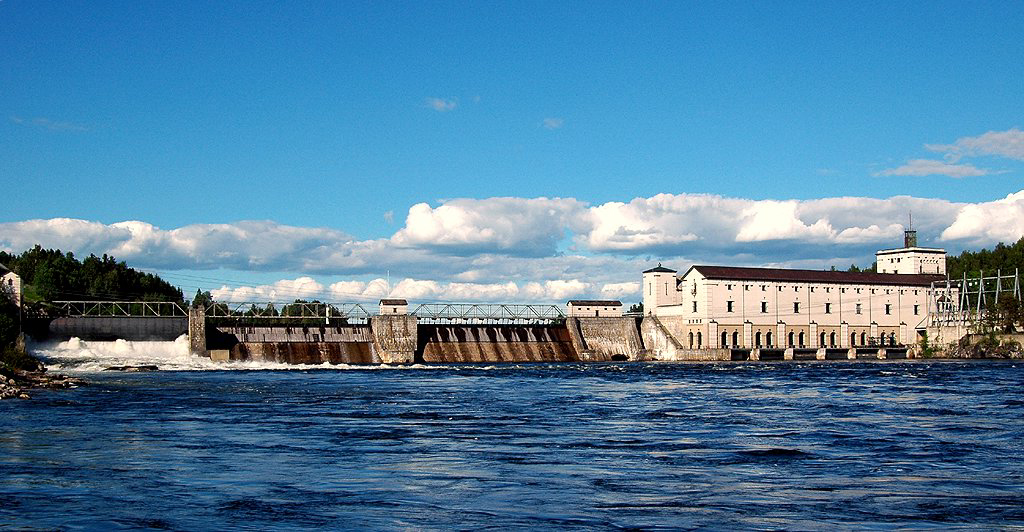
The same value substitution logic used with Saudi Arabia can be applied to Norway. Norway gets 99% of their electricity from their hydroelectric dams. Hypothetically, if the value of the electricity from their dams exceeded the cost of the electricity from solar it would be in their best interest to install solar.

One might reasonably ask... How could the value of hydroelectricy ever exceed the cost of solar? It's a fair question but remember that 10 years ago oil sold for under $30/barrel and photoelectrics cost four times what they do today. A lot can change in 10 years.

What could change in electricity markets to make Norway's hydroelectricity more valuable than solar electricity? Here are two general possibilities.

1. Hydoelectric dams can be used to provide regulating services in addition to generic kilowatt-hours. In high variable power scenarios you need a lot of regulation - high demand for regulation services raises the value for those services. Is it enough to make hydro more valuable than solar? Probably not but it will make things interesting.

2. Electricity pricing dynamics have changed significantly over the last decade as wind and solar resources have entered the market. It's difficult to project how these dynamics will evolve over the next decade but we can speculate. An often overlooked dynamic when it comes to solar vs. conventional power is that solar makes conventional power more expensive by stealing market share. In 2012 solar stole an additional 7 TWh of market from conventional power plants in Germany. This means the production costs at the effected conventional power plants actually went up due to their fixed costs being divided by lower production. If this trend continues we can imagine a lot of Combustion Turbine power plants going out of business. When you take those CTs out of the equation it changes the supply/demand picture - prices during the winter peak or the summer shoulder periods could become quite peaky with fewer CTs left to compete for that market. This is where hydro from Norway swoops in and makes a go of it.

This is all meant to be a thought exercise... The product (solar in Norway for example) isn't important here. The process (value substitution) is what I'm trying to get at.